English Springer Spaniel Health Risks — What Every Owner Should Know
English Springer Spaniel health risks deserve attention because this energetic sporting breed carries several inherited orthopedic, eye, blood, and neurologic disorders documented in veterinary literature. Current evidence highlights developmental hip dysplasia, chronic otitis externa, progressive retinal atrophy, phosphofructokinase deficiency, and inherited epilepsy as the most important breed-linked concerns. These findings do not mean every English Springer Spaniel will become ill, but they do show where ear monitoring, genetic screening, and age-based veterinary follow-up matter most. English Springer Spaniel health problems, English Springer Spaniel common diseases described in those sources, and the ages when those risks become most relevant are summarized below in a DVM-reviewed guide.
Most Common Health Conditions in English Springer Spaniels
Hip Dysplasia
Hip dysplasia is a developmental orthopedic disorder in which the hip joint forms abnormally, increasing the chance of pain and later arthritis. OFA registry data for English Springer Spaniels reports 13.0% dysplastic findings from 20,440 evaluations, with Swedish registry data showing a very similar prevalence signal. Early signs can include stiffness, reluctance to jump, reduced enthusiasm for exercise, or altered rear-limb movement in young adults.
Otitis Externa / Chronic Ear Disease
Otitis externa is one of the most important early-life health concerns in English Springer Spaniels because long, pendulous ears and chronic moisture retention create the perfect setting for repeated ear inflammation. Kaimio et al. reported a 19.6% prevalence in 491 English Springer Spaniels from Finnish veterinary records. Recurrent head shaking, scratching, odor, and dark debris should therefore be treated as significant breed-pattern warning signs rather than minor grooming issues.
Progressive Retinal Atrophy (PRA / RPGRIP1)
Progressive retinal atrophy is a key inherited eye disease in English Springer Spaniels, with RPGRIP1 or cord1-related forms receiving the strongest published attention. Narfström et al. characterized the mutation in the breed, and University of Missouri summaries report that dogs testing genetically affected are roughly 20 times more likely to develop PRA. Typical concern begins when dogs hesitate in dim light, struggle on stairs at night, or slowly lose confidence in unfamiliar spaces.
Phosphofructokinase Deficiency (PFK)
PFK deficiency is an inherited enzyme disorder seen in English Springer Spaniels and only a small number of other breeds. Screening data summarized in OMIA reports that, among 600 English Springer Spaniels tested in the United States, 14% were carriers and 6% were affected. Clinical signs often relate to exercise-triggered weakness, dark urine, abnormal breathing after exertion, or stress-related lethargy rather than constant daily illness.
Idiopathic Epilepsy
English Springer Spaniels are listed in the IVETF epilepsy consensus report as a breed with evidence for inherited epilepsy based on pedigree studies. The main clinical window of concern is from one to five years of age, when recurrent seizure episodes may first emerge in otherwise healthy young adults. Because many affected dogs are normal between events, careful history and video recording of episodes are often important to early assessment.
Health Risks by Age for English Springer Spaniels
Based on peer-reviewed evidence and registry-supported breed data.
| Age Range | Conditions to Watch | Why This Age Matters | Vet Action Recommended |
|---|---|---|---|
| 0–3 years | Otitis externa, PFK deficiency, hip dysplasia (developmental) | Ear disease can begin early, inherited PFK signs may emerge with exertion, and developmental orthopedic issues become clearer as growth finishes | Routine ear checks, orthopedic exam with imaging when indicated, and DNA testing if PFK is a breeding-line concern |
| 2–8 years | Progressive retinal atrophy | Inherited retinal degeneration often becomes more noticeable once night-vision changes begin | Arrange ophthalmic assessment if low-light hesitation, stair trouble, or visual uncertainty appears |
| 1–5 years | Idiopathic epilepsy onset window | Most clinical concern for inherited epilepsy appears in young to early-middle adulthood | Neurologic workup after any first seizure-like episode and keep a detailed event log |
| 6+ years | Chronic ear recurrence, orthopedic wear, ongoing eye and neurologic follow-up | Cumulative inflammation and age-related decline can compound pre-existing breed risks | Senior wellness visits every 6 months with mobility, ear, eye, and neurologic review |
Symptoms to Watch For
Contact your veterinarian promptly if you notice any of the following signs in your English Springer Spaniel.
- Head shaking, ear scratching, unpleasant ear odor, or dark discharge that may indicate otitis externa.
- Stiffness, altered rear-limb movement, or reluctance to jump that may indicate hip dysplasia.
- Night-vision hesitation, bumping into objects in dim light, or uncertainty on stairs that may indicate progressive retinal atrophy.
- Exercise intolerance, pale gums, dark urine after exertion, or stress-related weakness that may indicate PFK deficiency.
- Recurrent seizure episodes, collapse, or post-event confusion that may indicate idiopathic-epilepsy.
English Springer Spaniel Breed Profile
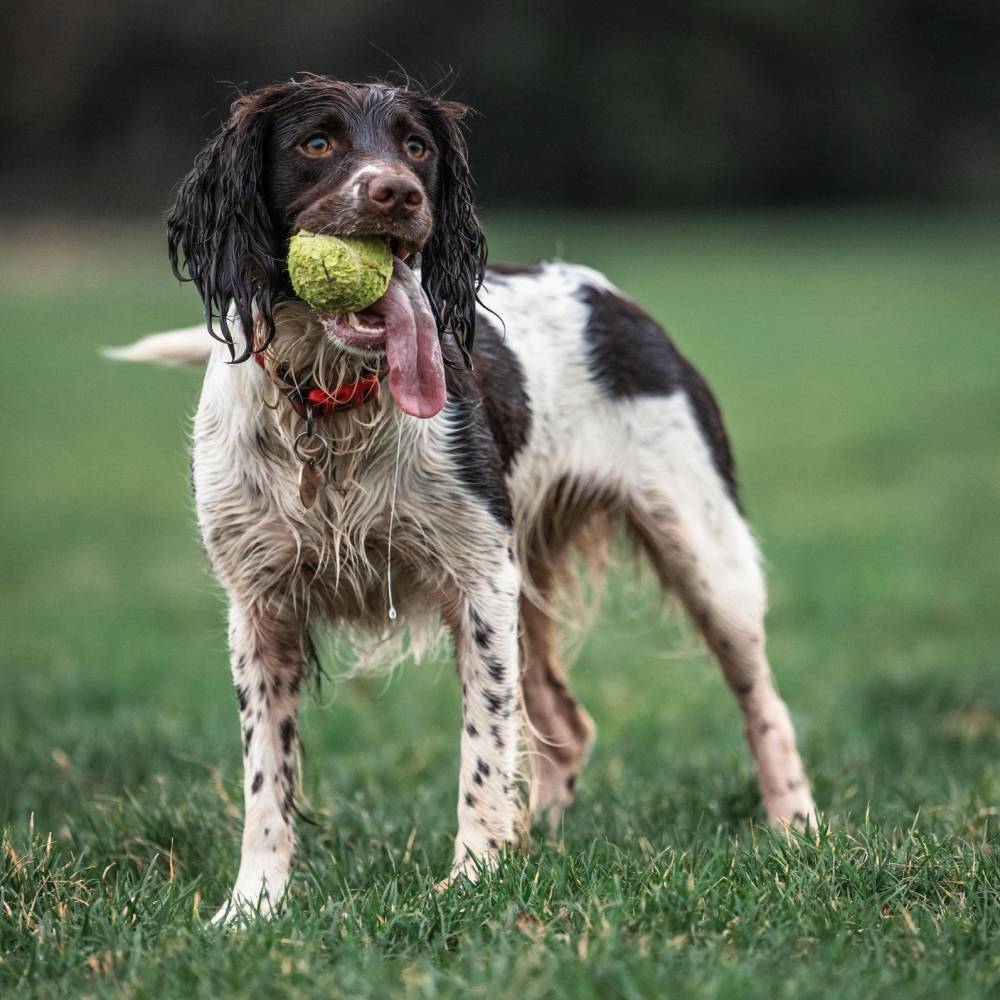
- Breed group: Sporting
- Life span: 12 – 14 years
- Weight: 18 – 25 kg (40 – 55 lbs)
- Height: 46 – 56 cm (18 – 22 in)
- Temperament: Friendly, Playful, Obedient, Active
- Bred for: Flushing and retrieving game birds
- Origin: United Kingdom
Research Sources
All health data on this page is drawn from peer-reviewed veterinary studies and official registry datasets.
- OFA Hip Dysplasia Statistics — English Springer Spaniel, 20,440 evaluations; Engdahl et al. 2026 — Veterinary Record. ofa.org/diseases/hip-dysplasia/
- Kaimio et al. 2017 — Acta Veterinaria Scandinavica 59:14 — otitis externa in spaniels.
- Narfström et al. 2012 — PMC3328374 — RPGRIP1 and PRA in English Springer Spaniels. PMC3328374
- Skibild 2001 / Giger et al. 1986 — PFK deficiency in English Springer Spaniels; OMIA 000421-9615. omia.org/OMIA000421/9615/
- Berendt et al. 2015 — IVETF Consensus Report — s12917-015-0461-2 — epilepsy in companion animals. doi:10.1186/s12917-015-0461-2
Read our full guide: Epilepsy in Dogs: Breeds, Signs, and What Vets Look For
Frequently Asked Questions
Are English Springer Spaniels prone to chronic ear disease?
Yes. The cited Finnish veterinary-record study reported otitis externa in 19.6% of English Springer Spaniels, which means chronic ear disease is one of the most important early-life health issues to monitor in this breed. Discuss your dog's individual risk with your veterinarian.
What eye disease risk matters most in English Springer Spaniels?
Progressive retinal atrophy linked to the RPGRIP1 or cord1 mutation is the key inherited eye concern, because genetically affected English Springer Spaniels are reported to be about 20 times more likely to develop PRA. Discuss your dog's individual risk with your veterinarian.
What is phosphofructokinase deficiency in English Springer Spaniels?
Phosphofructokinase deficiency is an inherited enzyme disorder that can cause exercise intolerance, dark urine after exertion, weakness, and stress-related episodes in English Springer Spaniels, even though many affected dogs otherwise live fairly normal lives. Discuss your dog's individual risk with your veterinarian.
Get a personalised health forecast for your English Springer Spaniel based on age, sex, and lifestyle.
Run the Free Health Forecast