Bernese Mountain Dog Health Risks — What Every Owner Should Know
Bernese Mountain Dog health risks stand out among large working breeds because cancer burden, neurologic predisposition, and developmental joint disease converge in veterinary literature more often here than in many peers. Breed-disposition reviews highlight histiocytic sarcoma and overall cancer mortality, molecular surveys document a unique two-mutation degenerative myelopathy background, and Swedish plus OFA registries confirm high hip and elbow dysplasia rates. No single dog will experience every problem, but these threads guide how owners plan screening from puppyhood through the breed’s relatively compressed median lifespan. Bernese Mountain Dog health problems, Bernese Mountain Dog common diseases emphasised in those sources, and checkpoints across Bernese Mountain Dog lifespan structure the summary below. All statements on this page are DVM-reviewed and sourced from the studies listed at the end.
Most Common Health Conditions in Bernese Mountain Dogs
Histiocytic Sarcoma
Histiocytic sarcoma is an aggressive histiocytic-lineage malignancy that may present with systemic illness before a primary mass is obvious. Dobson’s breed-cancer review notes that disseminated histiocytic sarcoma alone can account for up to about 25% of all Bernese Mountain Dog deaths, while overall cancer-related mortality in the breed approaches roughly 46%—among the highest figures tabulated for pedigree dogs. Because disseminated forms often progress within weeks of diagnosis, prompt staging when vague signs appear is especially important in this breed.
Degenerative Myelopathy (SOD1)
Degenerative myelopathy is a progressive spinal cord disorder classically linked to the SOD1 c.118G>A variant. Maki and colleagues’ European molecular survey emphasises that Bernese Mountain Dogs are unique in frequently carrying a second missense variant (c.52A>T, p.S18T) alongside the common allele, meaning risk conversations may need both assays for completeness. Clinical signs usually emerge in mature to senior dogs and mirror other large-breed presentations: dragging nails, crossing hind limbs, and weakness that creeps cranially over months.
Hip Dysplasia
Hip dysplasia reflects abnormal coxofemoral development that predisposes dogs to early osteoarthritis. OFA statistics report a 16.0% dysplastic rate across more than 31,000 Bernese Mountain Dog hip evaluations, while Swedish registry work tallies 14.7% of dogs in the worst hip grades. Expect subtle gait changes, exercise reluctance, or difficulty rising in young adults when dysplasia is clinically significant.
Elbow Dysplasia
Elbow dysplasia encompasses developmental incongruity of the elbow joint and often surfaces as front-limb lameness in growing large breeds. Engdahl’s 2026 Swedish cohort records 17.0% elbow dysplasia among nearly 4,000 Bernese Mountain Dogs—one of the highest breed prevalences in that national dataset—while UK genetic analyses report outsized additive genetic variance for elbow scores in the breed. Lameness after play, head-bobbing at the trot, or elbow swelling in puppies warrants early radiography.
Health Risks by Age for Bernese Mountain Dogs
Based on peer-reviewed mortality reviews, molecular surveys, and national screening data referenced on this page.
| Age Range | Conditions to Watch | Why This Age Matters | Vet Action Recommended |
|---|---|---|---|
| 0–1 years | Elbow dysplasia (developmental), hip joint formation | Rapid growth and heavy bone mass load immature elbow and hip conformation | Lameness evaluation with elbow and hip radiographs when indicated; discuss exercise moderation |
| 1–3 years | Hip dysplasia (clinical onset), ongoing elbow disease | Developmental orthopedic pain frequently surfaces as young dogs enter adult sports or work | OFA-style or PennHIP screening before intense conditioning; orthopedic rehab planning |
| 6–10 years | Histiocytic sarcoma, other neoplasia, early degenerative myelopathy vigilance | Breed mortality data concentrate cancer deaths in mature adults; DM genetics warrant spinal awareness heading toward senior life | Twice-yearly exams with thoracic/abdominal imaging if systemic signs emerge; baseline neurologic exam |
| 8–14 years | Degenerative myelopathy progression, chronic orthopedic pain | DM clinical windows overlap late middle age in large dogs; arthritis accumulated from youthful dysplasia dominates comfort | Neurologic reassessment for knuckling or weakness; multimodal osteoarthritis management |
Symptoms to Watch For
Contact your veterinarian promptly if you notice any of the following signs in your Bernese Mountain Dog.
- Unexplained weight loss, lethargy, firm lymph nodes, or laboured breathing that may indicate histiocytic sarcoma or other cancer.
- Dragging toenails, hind-limb incoordination, or progressive weakness that may indicate degenerative myelopathy.
- Bunny-hopping, difficulty rising, or hip pain after exercise that may indicate hip dysplasia.
- Front-limb lameness, elbow swelling, or pain on elbow extension that may indicate elbow dysplasia.
Bernese Mountain Dog Breed Profile
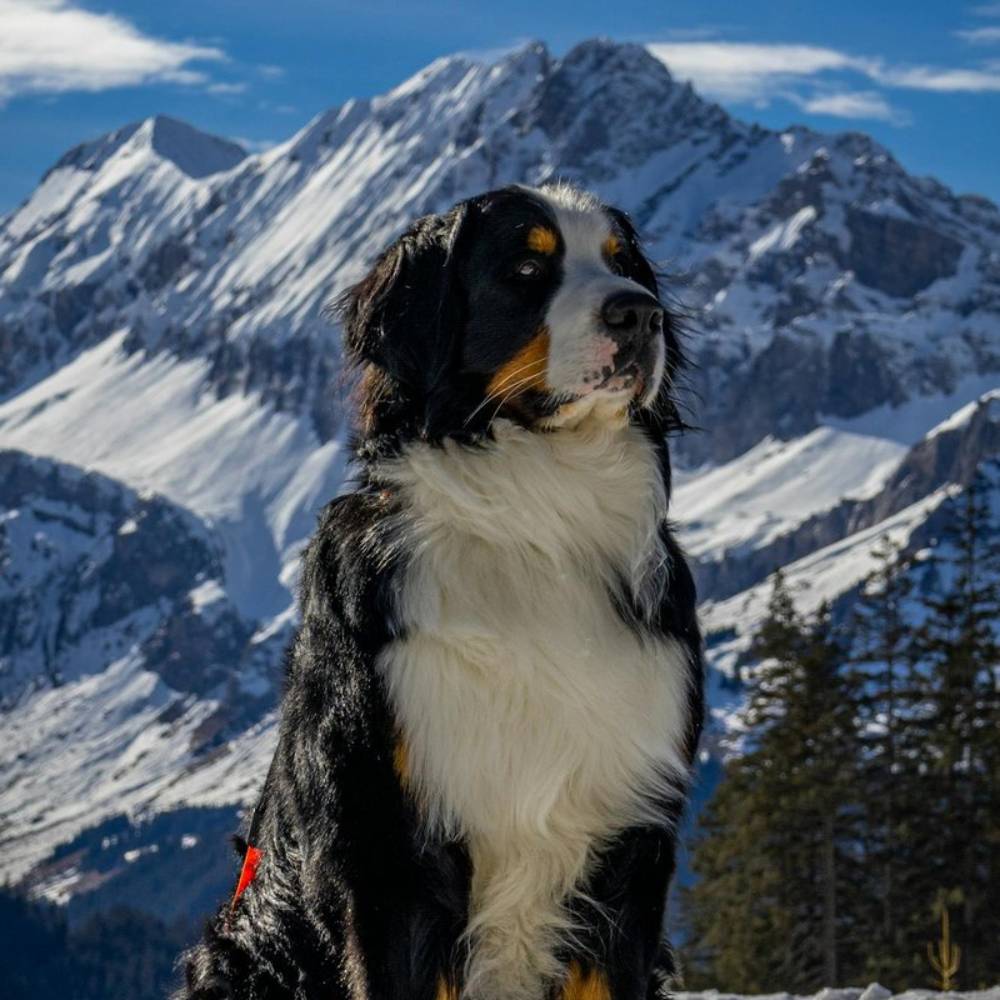
- Breed group: Working
- Life span: 7 – 10 years
- Weight: 32 – 52 kg (70 – 115 lbs)
- Height: 58 – 70 cm (23 – 28 in)
- Temperament: Affectionate, Loyal, Intelligent, Gentle
- Bred for: Drafting, droving and farm work in the Swiss Alps
- Origin: Switzerland
Research Sources
All health data on this page is drawn from peer-reviewed veterinary studies and official registry datasets.
- Dobson JM 2013 — Breed-Predispositions to Cancer in Pedigree Dogs — ISRN Veterinary Science
- Maki et al. 2022 — Animals 12:1647 — Degenerative Myelopathy molecular survey
- OFA Hip Dysplasia Statistics — Bernese Mountain Dog, 31,233 evaluations
- Engdahl et al. 2026 — Veterinary Record — hip and elbow dysplasia prevalence in Sweden
Read our full guide: Hip Dysplasia in Dogs — What Every Owner Should Know
Read our full guide: Epilepsy in Dogs: Breeds, Signs, and What Vets Look For
Frequently Asked Questions
Why is cancer risk emphasized for Bernese Mountain Dogs?
Breed-level mortality reviews report that cancer accounts for a very large share of Bernese Mountain Dog deaths, with disseminated histiocytic sarcoma alone contributing up to roughly a quarter of all deaths in some datasets. Discuss your dog's individual risk with your veterinarian.
What is different about degenerative myelopathy testing in Bernese Mountain Dogs?
Population surveys show Bernese Mountain Dogs can carry both the common SOD1 missense change and a second breed-specific variant, so complete genetic risk discussion may require two targeted molecular tests rather than one. Discuss your dog's individual risk with your veterinarian.
When should Bernese Mountain Dog owners prioritize hip and elbow screening?
Registry data place Bernese Mountain Dogs among breeds with high hip and elbow dysplasia frequency, so structured orthopedic exams in the first year and formal radiographic screening before heavy sport or breeding plans are clinically reasonable. Discuss your dog's individual risk with your veterinarian.
Get a personalised health forecast for your Bernese Mountain Dog based on age, sex, and lifestyle.
Run the Free Health Forecast