Shar Pei Health Risks — What Every Owner Should Know
Shar Pei’s heavy folds and narrowed ear canals concentrate moisture, heat, and friction in ways that differ sharply from smooth-coated sporting breeds. National VetCompass primary-care work documents very high annual-care rates for entropion and otitis alongside breed-defining familial Shar Pei fever signal, while dermatology epidemiology flags Shar Peis among the most fold-predisposed dogs; OFA hip tables add a double-digit dysplasia fraction despite a medium frame. BreedRisk frames Shar Pei health risks by life stage without implying every individual will face each diagnosis. Narrative below synthesises O’Neill et al.’s Shar Pei VetCompass profile, May–Segev–Rivas amyloid–FSF literature, Pye et al.’s skin-fold work, and OFA hip statistics alongside RVC VetCompass-style preventive context, AAHA-aligned exam expectations, and OFA structural screening conventions, with all content reviewed by Dr. Paulo Morouço, DVM.
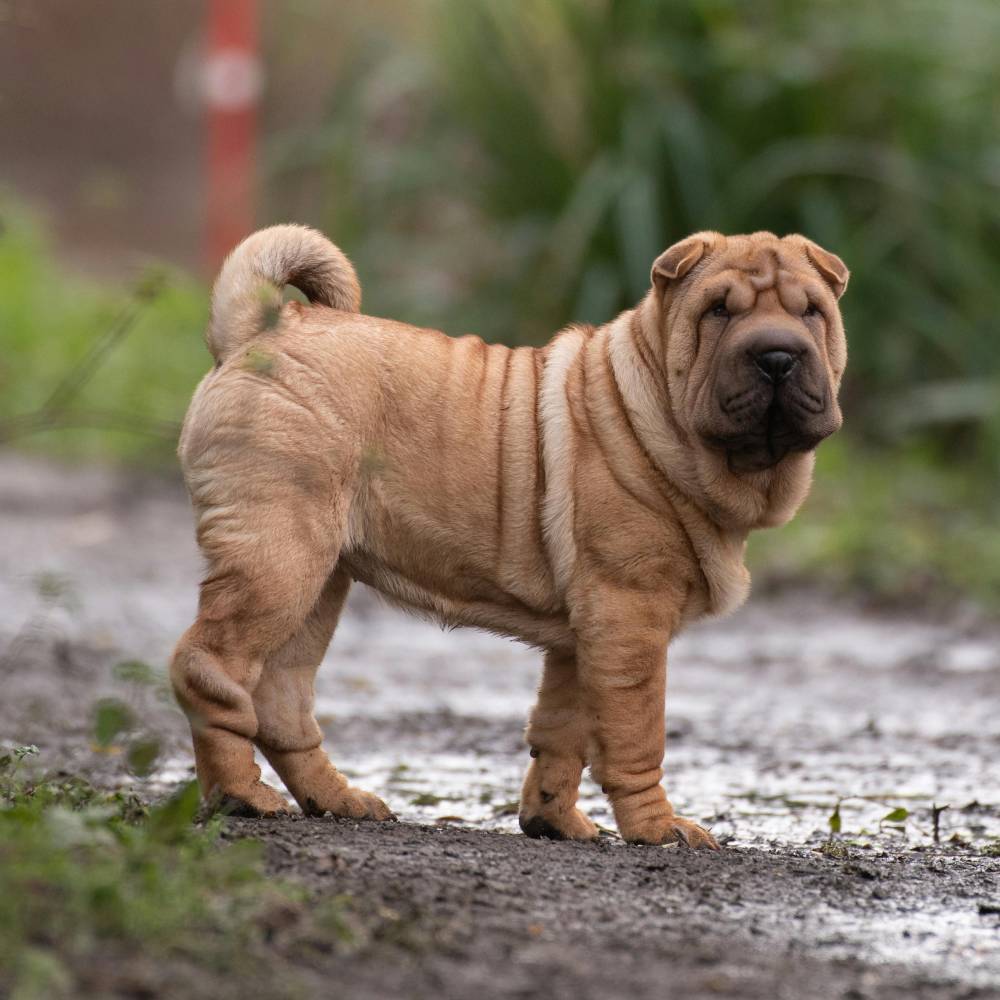
Most Common Health Conditions in Shar Peis
Familial Shar Pei Fever (FSF) and Amyloidosis Risk
Familial Shar Pei fever clusters inflammatory episodes that can include fever, swollen hocks, muzzle swelling, gastrointestinal upset, and profound lethargy — often resolving within a day or two yet recurring across years. May-era Shar Pei cohort statistics cited in amyloid-focused reviews underpin the breed-specific burden, while Segev’s amyloid case series underscores Shar Pei over-representation among dogs with renal amyloid deposition, and Rivas’s heredity paper frames recessive risk structures within lines. Because amyloid-related renal disease often carries grave prognosis once clinically apparent, transparent communication about episode frequency and urine protein screening belongs in wellness planning for at-risk individuals. (May et al. 1992 cited in UFAW Shar Pei amyloidosis overview; Segev et al. 2012, JVIM; Rivas et al. 1993, Journal of Heredity 84:438–442.)
Entropion
Entropion inverts eyelid margins so folded skin and lashes abrade the cornea with every blink — a mechanical consequence of extreme periocular redundancy unique to a handful of breeds. O’Neill’s VetCompass Shar Pei paper documented entropion among the dominant annual disorder diagnoses in a cohort of nearly two thousand dogs, with prevalence approaching one-fifth of the population under primary-care surveillance — vastly higher than non–Shar Pei comparators in the same study architecture. That epidemiological footprint means breeders and new owners should expect ophthalmic vocabulary — squinting, epiphora, mucoid discharge, and blepharospasm — to surface early rather than late in life. (O’Neill et al. 2023, Companion Animal Health and Genetics; PMC10720141.)
Otitis Externa / Chronic Ear Disease
Otitis externa inflames the external ear canal lining, yielding head shaking, malodor, exudate, and tenderness when the canal turns narrow or tortuous from adjacent skin bulk. In O’Neill’s Shar Pei cohort, annual otitis disorder prevalence remained in the mid-teens percentage range, more than double the non–Shar Pei baseline reported alongside it — exactly the pattern expected when chronically thickened folds narrow canal diameter. Recurrent otitis in this breed therefore blends dermatologic mechanics with infectious persistence, demanding otoscopic culture insight rather than casual ear-clean recommendations alone. (O’Neill et al. 2023, PMC10720141.)
Skin Fold Dermatitis / Pyoderma
Skin fold dermatitis traps moisture and commensal overgrowth within redundant tissue, producing erythema, exudate, pruritus, and recurrent pyoderma that can generalise if reservoirs persist. VetCompass registers Shar Peis in the ultra-predisposition tier alongside English and French Bulldogs and Pugs in Pye’s nationwide epidemiology paper, while O’Neill quantifies measurable annual pyoderma disorder frequency in primary care. Owners therefore balance fold hygiene, obesity management, and allergy workups differently here than in short-coated working dogs with open ventral skin. (Pye et al. 2022, Scientific Reports, PMC9259571; O’Neill et al. 2023, PMC10720141.)
Hip Dysplasia (Developmental)
Hip dysplasia describes coxofemoral laxity and remodelling that can culminate in OA pain even without dramatic early gait drama. OFA’s Chinese Shar-Pei row shows roughly thirteen percent dysplastic findings across thousands of evaluations — material risk for a midsize non-giant dog and justification for maintaining PennHIP or OFA discussions whenever hind-limb symmetry falters during growth. Because developmental dysplasia intersects exercise-load decisions during adolescence, consistent messaging around weight trajectory and symmetry matters. (OFA Hip Dysplasia Statistics — Chinese Shar-Pei, 9,470 evaluations.)
Health Risks by Age for Shar Peis
Mapped to published onset windows for familial fever, ophthalmic, dermatologic, otologic, and orthopaedic surveillance priorities discussed above.
| Age Range | Conditions to Watch | Why This Age Matters | Vet Action Recommended |
|---|---|---|---|
| 0–2 years | Entropion signs; otitis first episodes; fold dermatitis; developmental hip pain or asymmetry | Rapid facial growth interacts with eyelid mechanics while cartilage still moulds in hips | Ophthalmic exam before puppy purchase when possible; ear-canal assessment after repeated shake episodes; hip palpation and radiograph planning if gait shifts |
| 1–6 years | Familial Shar Pei fever episodes; recurrent pyoderma flares | Historical fever cohorts emphasise young-adult disease activity overlapping with show and sport lifestyles | Fever and hock-swelling logs shared with your clinic; urine protein screening per clinician judgement after episodes |
| 3–8 years | Otitis persistence; overweight-driven fold moisture; early osteoarthritis from dysplastic hips | VetCompass-level prevalence implies maintenance cleaning and allergy control, not sporadic attention | Recheck otoscopy when odour recurs; nutritional body-condition counselling; mobility and pain scoring if stairs become effortful |
| 7+ years | Amyloid-related renal disease in previously febrile lines; chronic OA; recurrent infections | Amyloid case literature ties earlier inflammatory signalling to renal endpoints in Shar Peis | Chemistry panels including renal indices; blood-pressure trend checks; compassionate multimodal pain planning when arthritis progresses |
Symptoms to Watch For
Contact your veterinarian promptly if you notice any of the following signs in your Shar Pei.
- Recurrent fever spikes with stiff, fluid-padded hocks suggesting Familial Shar Pei fever activity.
- Blepharospasm, mucoid ocular discharge, or episodic squinting characteristic of entropion-related corneal contact.
- Head tilt, malodor, or brown exudate aligning with stenotic canal otitis.
- Erythematous, moist intertrigo between folds or recurrent pyoderma patches despite bathing.
- Hind-limb sway, bunny-hopping, or post-rest stiffness compatible with developmental hip dysplasia progression.
Shar Pei Breed Profile
- Breed group: Non-Sporting
- Life span: 8 – 12 years
- Weight: 18 – 25 kg (40 – 55 lbs)
- Height: 44 – 51 cm (17 – 20 in)
- Temperament: Loyal, Independent, Calm, Devoted
- Bred for: Hunting, herding and guarding
- Origin: China
Research Sources
All health data on this page is drawn from peer-reviewed veterinary research and official screening registries referenced below.
- O’Neill et al. 2023 — Companion Animal Health and Genetics — VetCompass — Health of Shar Pei in UK primary-care — PMC10720141 ↗
- May et al. 1992 / Segev et al. 2012 — JVIM — Familial Shar Pei fever and renal amyloidosis; Rivas et al. 1993 — Journal of Heredity 84:438–442 — PMID 22192185 ↗
- Pye et al. 2022 — Scientific Reports — skin fold dermatitis epidemiology in UK dogs — PMC9259571 ↗
- OFA Hip Dysplasia Statistics — Chinese Shar-Pei, 9,470 evaluations — ofa.org ↗
Frequently Asked Questions
How common is familial Shar Pei fever?
Population-level Shar Pei cohort work cited in breed amyloid reviews describes familial Shar Pei fever affecting a substantial minority of dogs, with amyloid case series emphasising Shar Pei over-representation among dogs with renal amyloidosis; fever episodes often start in young adulthood and can relate to later renal amyloid risk. Discussing episode logs and urine protein trends with your clinic is central to individual monitoring. Discuss your dog's individual risk with your veterinarian.
Why do Shar Peis develop entropion and otitis externa so often?
UK VetCompass primary-care research on nearly two thousand Shar Peis reported very high annual disorder rates for both entropion and otitis externa, consistent with heavy periocular folds narrowing the external ear canal through redundant skin. Those findings exceed rates in dogs outside the breed in the same datasets. Discuss your dog's individual risk with your veterinarian.
What does hip dysplasia data show for Shar Peis?
Orthopedic Foundation for Animals registry tables list a double-digit dysplastic fraction among thousands of radiographically evaluated Chinese Shar-Peis, which is materially higher than casual stereotypes of medium dogs as universally low hip risk, so developmental hip screening still belongs in evidence-based conversations. Discuss your dog's individual risk with your veterinarian.
Get a personalised health forecast for your Shar Pei based on age, sex, and lifestyle.
Run the Free Health Forecast