Staffordshire Bull Terrier Health Risks — What Every Owner Should Know
Staffordshire Bull Terrier health reflects a muscular UK companion terrier lineage. Peer-reviewed research and curated screening datasets surface clear inherited risks for this breed. Breed-specific signals cluster around developmental hip dysplasia documented in Orthopedic Foundation statistics. They also include cancer-mortality burdens with mast cell tumour concern, juvenile hereditary cataracts tied to Heat Shock Factor 4 alterations, and L-2-hydroxyglutaric aciduria. Veterinary literature overwhelmingly associates L-2-hydroxyglutaric aciduria with Staffordshire Bull Terriers among pedigree dogs. That pattern does not mean every dog becomes ill. BreedRisk maps those themes into Staffordshire Bull Terrier health problems across life stages so owners can prioritise gait, ophthalmic and lump checks without alarmism. Narrative grounding below links OFA summaries, VetCompass-style population epidemiology portals such as the RVC VetCompass programme ↗, and companion animal preventive benchmarks discussed by AAHA ↗, with every paragraph reviewed by Dr. Paulo Morouço, DVM.
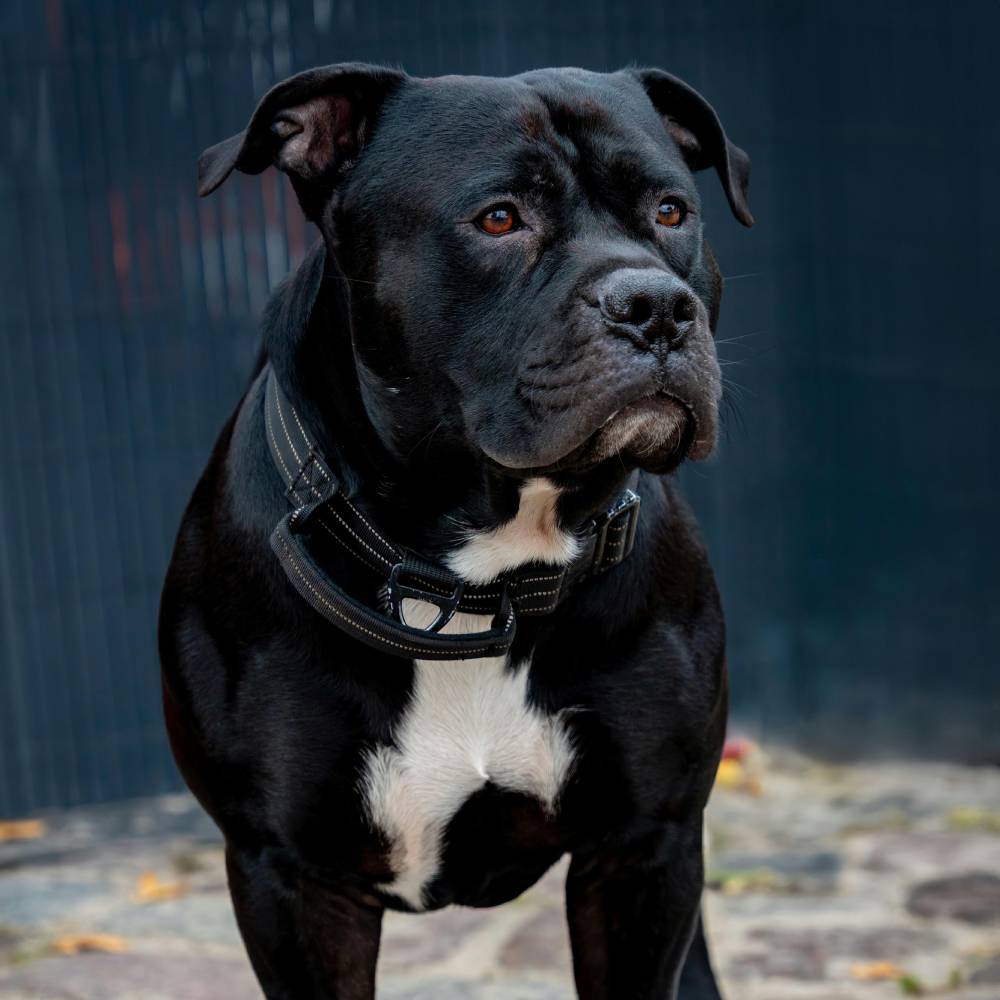
Most Common Health Conditions in Staffordshire Bull Terriers
Hip Dysplasia
Hip dysplasia causes malformed hip sockets that shear cartilage during growth. The condition often progresses to degenerative joint disease later in adulthood. OFA publishes breed-level hip dysplasia statistics reporting about 17.8% dysplastic evaluations among Staffordshire Bull Terriers in the historical registry dataset. That rate aligns with roughly one dysplastic hip for every six dogs radiographed within that screened population frame. Separate Swedish grading work also reports a higher denominator when mild radiographic variants are pooled. Those findings reinforce why breeders and pet owners prioritize structured exercise, lean body condition, and timely imaging when gait changes appear rather than delaying assessment. (Orthopedic Foundation for Animals; Engdahl et al. 2026, Veterinary Record.)
Mast Cell Tumour
Mast cell tumours belong to the most frequently encountered malignant skin tumour group in companion dogs. They can mimic innocent nodules despite variable biological behaviour in individual patients. Breed-disaggregated cancer mortality analysis attributes about 44.4% of Staffordshire Bull Terrier deaths to neoplastic disease. It assigns this breed an overall cancer-mortality risk ratio of 1.3 relative to broader pedigree reference categories. The analysis explicitly flags mast cell tumours alongside other common tumour types tracked in pedigree populations. Vigilant skin checks and prompt evaluation of new or changing lumps keep owners aligned with clinician recommendations for aspirate cytology versus excision planning. (Dobson JM, 2013. ISRN Veterinary Science.)
Juvenile Hereditary Cataracts (HSF4 / JHC)
Researchers first documented hereditary cataracts linked to Heat Shock Transcription Factor 4 mutations in Staffordshire Bull Terriers and in certain brachycephalic breeds that share the juvenile cataract phenotype. Dogs may present with progressive lens opacity from roughly the first birthday through toddler years. That presentation prompts referral for ophthalmologic confirmation when owners notice glare sensitivity, clumsiness indoors, or a cloudy-grey lens silhouette on casual inspection during bright light. Genetic testing marketed for juvenile hereditary cataract risk allows breeders and puppy buyers to make informed mating decisions aligned with veterinary genetic counselling messages. (Mellersh et al. 2006; Staffordshire Bull Terrier Club breed-health summaries; UC Davis Veterinary Genetics Laboratory JHC assay overview.)
L-2-Hydroxyglutaric Aciduria (L2HGA)
L2HGA is an autosomal recessive inborn error of metabolism. Neurometabolic injury builds when two copies of an L2HGDH mutant allele segregate together. Veterinary case series centred on Staffordshire Bull Terriers report mean clinical onset close to twelve months of age. Outliers span infancy into early adulthood depending on phenotype severity and owner recognition lag. Behavioural deterioration, intermittent stiffness after excitement, seizure activity, cerebellar-style tremors, and progressive ataxia are commonly emphasised retrospective descriptors. Those signs should trigger metabolomic and MRI discussions under specialist stewardship once differentials broaden beyond routine toxin or trauma screening. (Shea et al. 2016; Abramson et al. 2003.)
Health Risks by Age for Staffordshire Bull Terriers
Based on breed-specific peer-reviewed summaries and institutional screening datasets referenced on this guide.
| Age Range | Conditions to Watch | Why This Age Matters | Vet Action Recommended |
|---|---|---|---|
| 0–2 years | Hip dysplasia developmental phase; JHC onset; earliest L2HGA presentations | Skeletal modelling, lens maturation and rapid neurologic myelination converge in young dogs whose subtle gait or vision clues are easy to normalise accidentally | Orthopaedic evaluation with radiographs when lameness persists; ophthalmic slit-lamp referral if lenticular haziness emerges; breeder or rescue DNA counselling for cataract and L2HGA mutations |
| 3–6 years | Advanced cataract progression; arthritic fallout from unnoticed hip laxity | Owners often attribute declining athleticism solely to adulthood rather than painless lens blindness or budding arthritis | Annual comprehensive exam documenting vision-led navigation quirks; gait and pain scoring; revisit hip films if pelvic discomfort recurs episodically after hard play weekends |
| 7–13 years | Oncology vigilance centred on mast cell tumours amid elevated cancer-mortality attribution | Peer-reviewed pedigree datasets highlight tumour burden prominence around mature age brackets when immune surveillance subtly wanes despite outward pep | Body-map each skin fold monthly; biopsy-aspirate any firm nodules rather than topical watchful waiting alone; thoracic imaging when staging decisions arise |
| 13+ years | Multifactorial frailty — arthritis stacking, ophthalmic compromises, tumour surveillance | Senior physiology tolerates anesthesia and NSAID polypharmacy poorly without laboratory safety nets verifying renal and hepatic clearance | Twice-yearly geriatric labs; analgesia and mobility adjustment discussions; nuanced quality-of-life scoring when concurrent diseases intersect |
Symptoms to Watch For
Contact your veterinarian promptly if you notice any of the following signs in your Staffordshire Bull Terrier.
- Bunny-hopping pelvic motion, butt swaying on stairs, exercise fade after brisk walks suggesting hip dysplasia or secondary arthritis evolution.
- Diffuse lens clouding, tentative navigation of furniture edges at night or sudden photophobia consistent with progressing juvenile cataracts beyond early mild haze phases.
- Novel lumps that fluctuate hourly in size or feel doughy-deep rather than uniformly fatty — patterns sometimes linked with mast cell degranulation tumours deserving expedited aspiration.
- Exercise-linked hind-limb stiffness, episodic drunken weaving, unexplained tonic-clonic events, coarse head tremors, or personality shifts mimicking canine cognitive dysfunction when young-to-middle-aged implying metabolic neurologic emergencies such as L2HGA.
- Cluster seizures without toxin exposure correlating historically with neurologic degeneration case reports in this genotype background.
Staffordshire Bull Terrier Breed Profile
- Breed group: Terrier
- Life span: 12 – 14 years
- Weight: 11 – 17 kg (24 – 38 lbs)
- Height: 36 – 41 cm (14 – 16 in)
- Temperament: Courageous, Affectionate, Loyal, Intelligent
- Bred for: Bull baiting and later as a companion
- Origin: United Kingdom
Research Sources
All health data on this page is drawn from peer-reviewed veterinary research and official screening registries referenced below.
- OFA Hip Dysplasia Statistics — Staffordshire Bull Terrier, 552 evaluations; Engdahl et al. 2026 — Veterinary Record. ofa.org/diseases/hip-dysplasia/
- Dobson JM (2013). Breed-Predispositions to Cancer in Pedigree Dogs — ISRN Veterinary Science. doi:10.1155/2013/941275
- Mellersh et al. (2006). HSF4 mutation and juvenile hereditary cataracts in Staffordshire Bull Terriers; UC Davis VGL JHC testing overview. vgl.ucdavis.edu/test/juvenile-hereditary-cataract
- Shea et al. (2016). Veterinary Record 179:545 — L2HGA in 27 Staffordshire Bull Terriers — doi:10.1136/vr.103783
Frequently Asked Questions
What health problems are Staffordshire Bull Terriers prone to?
Registry and peer-reviewed data most often cite hip dysplasia (high rate in OFA evaluations), cancer concern including mast cell tumours, juvenile hereditary cataracts linked to HSF4, and L-2-hydroxyglutaric aciduria, which has been documented almost exclusively in this breed among dogs. These patterns inform screening and vigilance rather than predicting illness in every individual. Discuss your dog's individual risk with your veterinarian.
At what age do Staffordshire Bull Terriers typically show hip, eye or neurological signs?
Hip dysplasia is framed as a developmental orthopaedic concern often emerging between roughly one and three years of age, while published case series describe L2HGA with mean onset around twelve months though a wider age range occurs. Juvenile hereditary cataracts are often tracked from infancy into the first few years when lens changes progress toward severe vision loss if unchecked. Routine exams help catch shifting gait, cloudy lenses, or behaviour changes promptly. Discuss your dog's individual risk with your veterinarian.
How long do Staffordshire Bull Terriers live?
Breed summaries and club references commonly quote about twelve to fourteen years as a typical life span bracket, acknowledging individual variation influenced by genetics, preventive care, weight and exercise. Discuss your dog's individual risk with your veterinarian.
Get a personalised health forecast for your Staffordshire Bull Terrier based on age, sex, and lifestyle.
Run the Free Health Forecast