Hip Dysplasia in Dogs — What Every Owner Should Know
Hip dysplasia in dogs is one of the most common inherited orthopaedic conditions, affecting breeds of all sizes but most severely those with a genetic predisposition. The condition develops when the hip joint forms abnormally during growth, leading to instability, cartilage damage and — over time — painful secondary osteoarthritis. Understanding hip dysplasia health risks is especially important for owners of predisposed breeds, many of which show prevalence rates above 10% in official screening registries. This guide covers the cause, signs, diagnosis and risk factors in plain language, reviewed by Dr. Paulo Morouço, DVM.
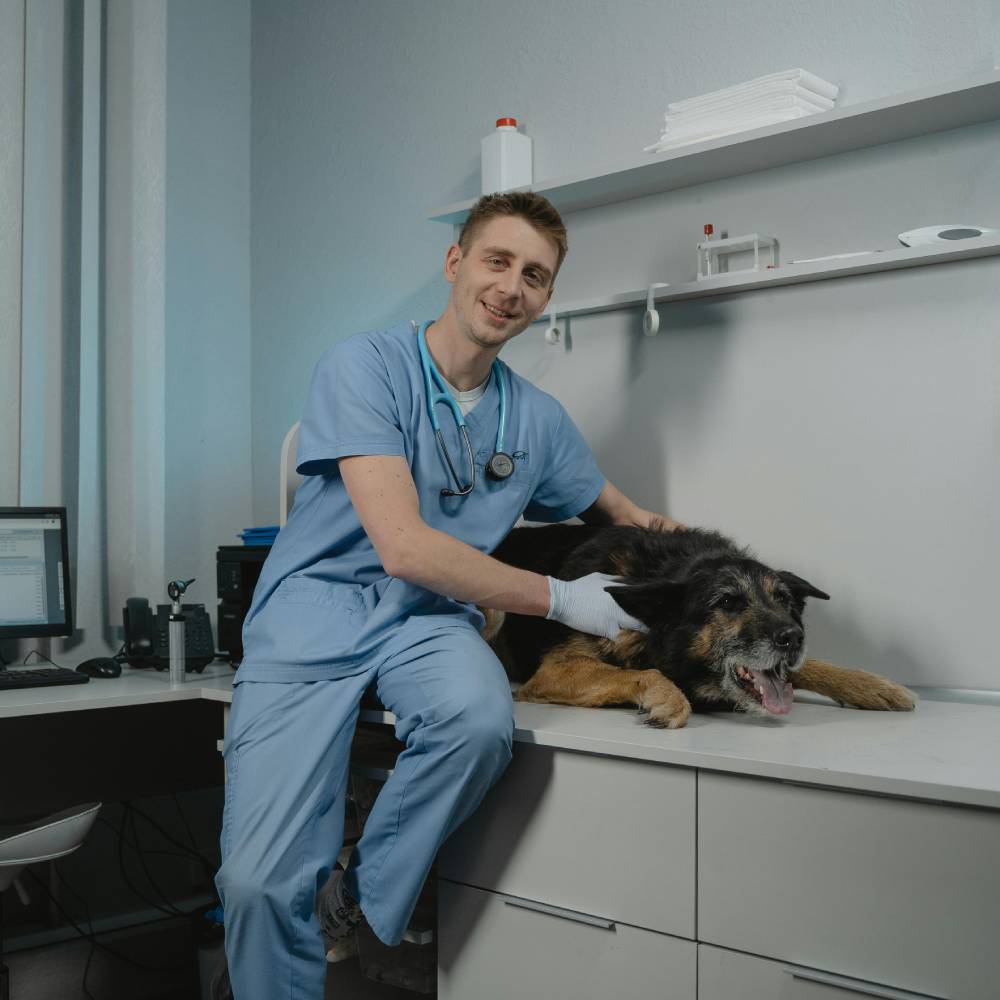
What Is Hip Dysplasia in Dogs?
Hip dysplasia is a developmental orthopaedic disorder where the hip joint appears normal at birth but develops abnormally during growth. The primary physiological issue is excessive joint laxity, which leads to subluxation of the femoral head and gradual flattening of the acetabulum.
The most critical period for hip joint development is between 3 and 9 months of age.
There are two distinct phases: developmental dysplasia (the initial malformation and joint laxity) and secondary osteoarthritis (the irreversible degeneration that follows). Once osteoarthritis is radiographically visible it will continue to progress.
Signs and Symptoms of Hip Dysplasia in Dogs
Understanding common hip dysplasia symptoms helps owners know when to seek veterinary advice. Early signs in puppies (6–12 months) include hind limb lameness, a bunny-hopping gait, reluctance to rise or jump, swaying hips when walking, and reduced activity compared to littermates.
Signs in adult dogs include progressive hind limb lameness, stiffness after rest, difficulty with stairs, muscle wasting in the hindquarters, and pain when the hip is manipulated.
Many dogs show no obvious signs until secondary osteoarthritis is established — regular screening in predisposed breeds is important.
Contact your veterinarian if you notice any of the following signs.
- Bunny-hopping run — both hind legs moving together
- Reluctance to rise from lying down
- Stiffness in the hind limbs after rest or exercise
- Swaying or rolling gait when walking
- Reduced willingness to jump, climb stairs or play
- Muscle wasting visible in the hindquarters
- Pain or sensitivity when the hip area is touched
Which Dog Breeds Are Most Affected by Hip Dysplasia?
The following hip dysplasia dog breeds in the BreedRisk database have documented prevalence data from official OFA screening or peer-reviewed European registries.
| Breed | OFA Prevalence | BreedRisk Guide |
|---|---|---|
| Pug | 66% | Pug health guide |
| Staffordshire Bull Terrier | 18% | Staffordshire Bull Terrier health guide |
| Bernese Mountain Dog | 16% | Bernese Mountain Dog health guide |
| Springer Spaniel | 13% | Springer Spaniel health guide |
| Shar Pei | 13% | Shar Pei health guide |
| German Shepherd | ~19% (OFA) | German Shepherd health guide |
| Rottweiler | ~20% (OFA) | Rottweiler health guide |
| Golden Retriever | ~11% (OFA) | Golden Retriever health guide |
| Labrador Retriever | ~10% (OFA) | Labrador Retriever health guide |
| Boxer | 11% (OFA) | Boxer health guide |
| Border Collie | 11% (OFA) | Border Collie health guide |
| Australian Shepherd | 6% (OFA) | Australian Shepherd health guide |
| Siberian Husky | 2% (OFA) | Siberian Husky health guide |
| Whippet | 1.3% (OFA) | Whippet health guide |
Prevalence figures are from OFA screening registries or peer-reviewed studies. OFA data reflects screened populations and may not represent the general breed population. Links lead to individual breed health guides on BreedRisk.
Risk Factors for Hip Dysplasia in Dogs
- Genetics: CHD is a complex polygenic trait influenced by the additive effects of many genes. Source: Lewis et al. 2013
- Rapid growth and overfeeding: High food intake and excessive weight gain during puppyhood significantly increase the risk and lead to earlier onset of secondary arthritis. Source: Hip and Elbow Dysplasia: Successes and Challenges
- Obesity: Excess body weight increases mechanical stress on joints and produces inflammatory mediators that accelerate joint damage. Source: Cornell CVM — Osteoarthritis
- Exercise during growth: Over-exercise on hard surfaces during the growth phase is a risk factor; conversely, a total lack of activity leads to poor hip musculature and reduced joint support. Source: Cornell CVM
- Early neutering: Removal of sex hormones before growth plates close has been associated with increased incidence of CHD in some breeds. Source: OFA
How Is Hip Dysplasia Diagnosed?
Physical examination: A veterinarian assesses gait, range of motion, pain response and muscle development.
Radiographic screening: The standard OFA procedure places the dog in dorsal recumbency with rear limbs fully extended; sedation or anaesthesia is required for accurate positioning.
Three board-certified veterinary radiologists independently evaluate each submission considering breed, sex and age.
The seven OFA grades (from reference sources) are:
- Excellent — superior conformation, deep-seated femoral head, tight fit
- Good — slightly less than superior but normal
- Fair — minor irregularities, still within normal limits
- Borderline — incongruent joint, no definitive arthritic changes yet
- Mild — significant subluxation, increased joint space
- Moderate — barely seated femoral head, secondary arthritic changes present
- Severe — femoral head partially or completely out of a shallow socket, significant arthritic changes
Screening age: OFA recommends 24 months for official certification; preliminary screening is possible from 4 months; European FCI screening from 12 months.
Hip Dysplasia in Dogs — Frequently Asked Questions
What are the first signs of hip dysplasia in dogs?
The earliest signs include hind limb lameness, a swaying gait, reluctance to rise or jump, and a characteristic bunny-hopping run where both hind legs move together. These signs typically appear between 6 and 12 months of age in affected puppies, though some dogs do not show obvious signs until adulthood when secondary osteoarthritis develops. Discuss your dog's individual risk with your veterinarian.
Which dog breeds are most prone to hip dysplasia?
Large and giant breeds are most commonly affected. The Pug has one of the highest recorded rates at 66% according to OFA data, followed by the Rottweiler, German Shepherd, Staffordshire Bull Terrier, Bernese Mountain Dog and Golden Retriever. However, hip dysplasia can occur in any breed including smaller dogs. Discuss your dog's individual risk with your veterinarian.
What do OFA hip grades mean for hip dysplasia?
The OFA uses seven grades. Excellent, Good and Fair are all considered normal — Excellent indicates superior joint conformation. Borderline means the joint is incongruent but without definitive arthritic changes yet. Mild, Moderate and Severe are all dysplastic grades, with Severe indicating the femoral head is partially or completely out of a shallow socket with significant arthritic changes. Discuss your dog's individual risk with your veterinarian.
At what age should dogs be screened for hip dysplasia?
OFA recommends screening at 24 months of age for official certification, as the hip joint has fully developed by this point and results are more reliable. Preliminary screening can be performed as early as 4 months to identify severe joint laxity, though these results are not used for official OFA grading. European FCI screening typically occurs from 12 months. Discuss your dog's individual risk with your veterinarian.
Can hip dysplasia be prevented in predisposed breeds?
The underlying genetic predisposition cannot be eliminated in an individual dog, but environmental risk factors can be managed. Avoiding overfeeding during puppyhood, maintaining a healthy body weight throughout life, and avoiding excessive exercise on hard surfaces during the growth phase can all reduce the severity of the condition in genetically predisposed dogs. Discuss your dog's individual risk with your veterinarian.
Hip Dysplasia Research Sources
- OFA — Hip Dysplasia information and screening
- OFA — Hip Grade Details
- Cornell University CVM — Canine Hip Dysplasia
- Lewis et al. 2013 — BMC Genetics — Genetic architecture of canine hip dysplasia
- Engdahl et al. 2026 — Veterinary Record — Prevalence of hip and elbow dysplasia in young adult dogs in Sweden
- Janutta & Distl 2008 — DTW Deutsche Tierarztliche Wochenschrift — Hip and Elbow Dysplasia: Successes and Challenges